Showing posts with label Hybrids. Show all posts

Friday, 3 May 2019

Exciting mangave update

So last year was a good mangave and manfreda year, with flowers on two manfredas, more on that in another post, and the mangave flowering.  So a quick recap: the mangave was produce by a friend and is hybrid between manfreda virginica and agave obscura


The pollen was provided by friends over at Crete Lodge exotic garden. They seem to have agaves in flower every year now, this time there were two agaves flowering at the same time. An agave mitis and one labelled as agave horrida, although they suspect it is not.

Photo courtesy of Melissa at Crete Lodge
Isn't that wall amazing, such a shame that the agave left such a big gap.

So the last time I posted progress on the flower spike there were seed pods. It seemed to take forever but finally these opened and amazingly there were seeds. These where sown and placed in a heated prop.  To be honest I was not that confident anything would germinate.

I was wrong, one month later and there were around 40 seedlings.


The problem was that in my eagerness, winter was the wrong time to sow them. They needed to be kept alive until spring and I'm terrible with seedlings: too much water, too little water. So I'm really surprised that 4 months later 19 are still alive. I'll take 50% surviving any day.


I know not very interesting to look at yet. It is only in the last few weeks they have really started to grow, most are now sending out their 2nd proper leaf. How good would it be to have a few new mangaves of my own making. I really hope that some of the horrida (or not) parentage comes through. I do like my toothie plants.

The funny thing is, with the two different pollen donars I would guess I am now the largest mangave producer in the UK. 

Sunday, 17 June 2018

The hardy aloes starting to flower

There are very few aloes that are hardy in the UK. A. striatula and A. Aristata are the two that seem hardy across larger parts of the Uk without needing any protection. Then A. polyphylla and A. saponaria in the warmer parts, or if given protection from the snow and rain. There are a few more people grow, but they seem to be much more variable.

So I grow all 4 in the garden and have had them all flower at different points, A. Polyphylla for the first time last year, but sadly not this year.  The rest are flowering better than ever. 


The photo above shows the largest clump of A. striatula. There are three clumps around the garden, all flowering and two, for once, aphid free.  You can see that it is rampant, and has turned my ordered, tidy succulent bed into more of a jungle.

There are two groups of A. aristata just out of the photo and several in pots.  I have them in pots so they can be moved to fill gaps, or placed next to other aloes in flower.

The A. saponaria I have is a variegated clump.  It started off as one plant, and is now a clump of variegated plants, some better than others. I am always surprised it survives each winter and then flowers. 

This years flower is the best to date. The flowers have good colour and are a decent size. In the morning sun it glows, the photo does not do it justice.

The bees are a bit unsure of the aloe flowers, they are finding out how to access them so seed pods have been few to date.  This year with everything flowering so well, it may be time to try some hybrids. I was thinking about which to try and remembered I already owned an A. aristata x A. striatula which is very disappointing in both looks and hardiness.   So it looks like it is going to be A. aristata x A. saponaria and A. strataula x A. saponaria instead.  To try and ensure the best success, I will be getting the paint brush out to help everything along. 

There are lots of other aloes in flower as well, mainly the smaller ones.  The only larger one in flower is no longer strictly an aloe, but kumara plicatilis. The flowers has lasted really well, holding their colour and not just opening and dieing with in a day or so.

Then you have the haworthias and the aloe x haworthis crosses, but that may have to be another year.


Tuesday, 18 June 2013

The 2013 echeveria hybrid strategy

Every year with so many echeverias in flower at the same time it is tough deciding what crosses to try. Do you go for a stronger colour, or in the case of the blue/white plants less colour.  Perhaps try for a larger flower, or my usual aim for more hardiness.  The problem with so many experiments, is remembering what was crossed with what. So this year to simplify everything, I have selected one pollen donor and am using it on all the other plants.  The lucky plant is graptopetalum  tacitus bellus


The flowers are a shocking pink, the plants offset freely and have good tight rosettes which don't get too leggy.  It doesn't matter that it's a graptopetalum, they will hybridise with echeverias producing graptoverias. The other factor than finalised the selection were the heavily pollen covered anthers. These can be removed with tweezers and used directly to apply pollen to the stigmas on the other plant. No pots full of paint brushes this year.

The plants tried so far are: E. 'Crugs Ice'. A more vertical growing form, with strong orange flowers.


E. setosa deminuta, a nice small version of setosa.  Good colour, good offsets, very bright yellow and red flowers.

Finally for the ones tried so far, sedeveria letizia. A great plant and already a hybrid between a sedum and echeveria. I have no idea what you would call any resulting plants "graptosedeveria".


There are lots of echeverias in flower outside the greenhouse, but these are being left to the bees, who have finally worked out how to get to the flowers.  It was the same at the last house, it took a while for them to work out how to treat the various flowers they had never seen. Then once figured out,  news spread and the flowers were always covered in bees. The following years, the they seemed to remember and visited flowers as soon as they came out.

That's the echeverias, I'll cover aloes and dudleyas in another post.

Monday, 27 May 2013

The best of both: Sedevaria letizia

Hybrids are always an unknown entity, and when the parents are from two different families the outcome is even more uncertain.  Too often the result is the worst attributes of both so it is good to find plants that take the best attributes instead.

This sedum / echeveria hybrid, sedevaria letizia, must rank as one of my favourite plants: it ticks so many boxes.  It's a pretty plant and while it does form trunks these are easily controlled. It offsets nicely forming either small clusters, or nicely branched "trees". It flowers well, with almost pure white flowers. Finally it is cold tolerant and with rain protection gets through our winters without problems.


I have a few of these ready for planting out when there is a dry bed to put them in. The plant above is my favourite, I can't help but think it would make a spectacular bonsai plant. Wouldn't it look amazing clinging to the side of a rock, with its roots hanging down into the soil below. It does form aerial roots, which seem stable, so it should be possible. I just have to be brave enough to to risk the pant.

Friday, 7 September 2012

Agave hybrids: part 2

Looking though the photos of my purchases from the BCSS national show, I noticed that all my agave purchases were hybrids.  It was not planned, I purely bought plants that caught my eye on the day.  Part 1 of this post was on my friends a. obscura x a. lophantha hybrids, maybe it was being given these on the day of the national show that subliminally put hybrids into my head. The first purchase was a. isthmensis x colimana. You can't see the good red margins to the leaves in this photo.


The second purchase was one of the few a. bracteosa hybrids, A. 'Mateo'. I don't have a photo. but it is basically a wide leaved bracteosa with a pale mid stripe.  The final purchase is probably the stand out plant. I pointed it out to a friend to find out what it was, and he bought it, leaving me a much smaller one.  I wont be making that mistake again. It is a. macroacantha x appalanta


Looking at the photos reminds me I must pot them all up.  One of the strangest things about being in limbo while the new house is re-wired, is not being able to pop outside to look at the plants. Hopefully this weekend I will be allowed some time off to play in the garden and take some photos. I need to get going on the greenhouse for everything this winter, otherwise none of these new ones will survive.

Wednesday, 5 September 2012

Agave hybrids: part one.

Agave flowers in the UK used to be rare, with the amount of collections and time many growers have had their plants, they are getting more common every year. I know many people who have had not just one plant flower but several.  Once flowering, the ultimate dream for many growers is to produce a hybrid. So It is no surprise that more agave hybrids are coming on the market all the time, some purposely produced, others lucky coincidences. 

Once such event happened with a good friend.  His a. obscura came into flower and he managed to get hold of some pollen from a. lophantha. I was offered some of the resulting seed, but not having much luck with seeds I waited until there were some young plants. They seems to fall into two groups, one with a well defined mid stripe, the other with darker spines.


The one on the right has nice dark teeth and for me is the nicer of the two forms. I prefer good teeth to central stripes and it has a more defined look:


I am sure the donor will be asking for regular updates to check he hasn't given away the best plants. Mind you he has a few spares, plus a few hundred seeds left.

Thursday, 12 April 2012

The ugly duckling

There once was a little echeveria hybrid who felt very unloved compared to the other hybrids.  It wasn't its fault it didn't turn out as pretty as the others, after all you can't choose your parents. For years it was considered a poor echeveria agavoides hybrid while the other hybrids were pampered, named and given pride of place. The only bit of attention it was given was to humiliate it in a post here highlighting how plain it was.  Come winter it was put storage, tucked away at the back, out of sight and out of mind.

Come spring waking up, it tentatively put out its first flower spike.  Quietly not wanting to attract attention it opened its first flower hidden among the other plants.

Then something amazing happened, it noticed that the flower was being photographed and assumed that again it was to be humiliated. But it wasn't

Slowly it built in confidence and put out more flowers and with each flower it got more attention.  No one seemed to be laughing, instead the comments were about how good it looked.

Finally it was able to take pride of place. Its flowers the best on display, not at all like the lack lustre flowers of its parents.

Gone are the plain leaves, the loose shape, replaced by thick, pale blue leaves a nice round rosette and those lovely large flowers.


The ugly duckling was ugly no more.


Tuesday, 10 April 2012

Shed in flower

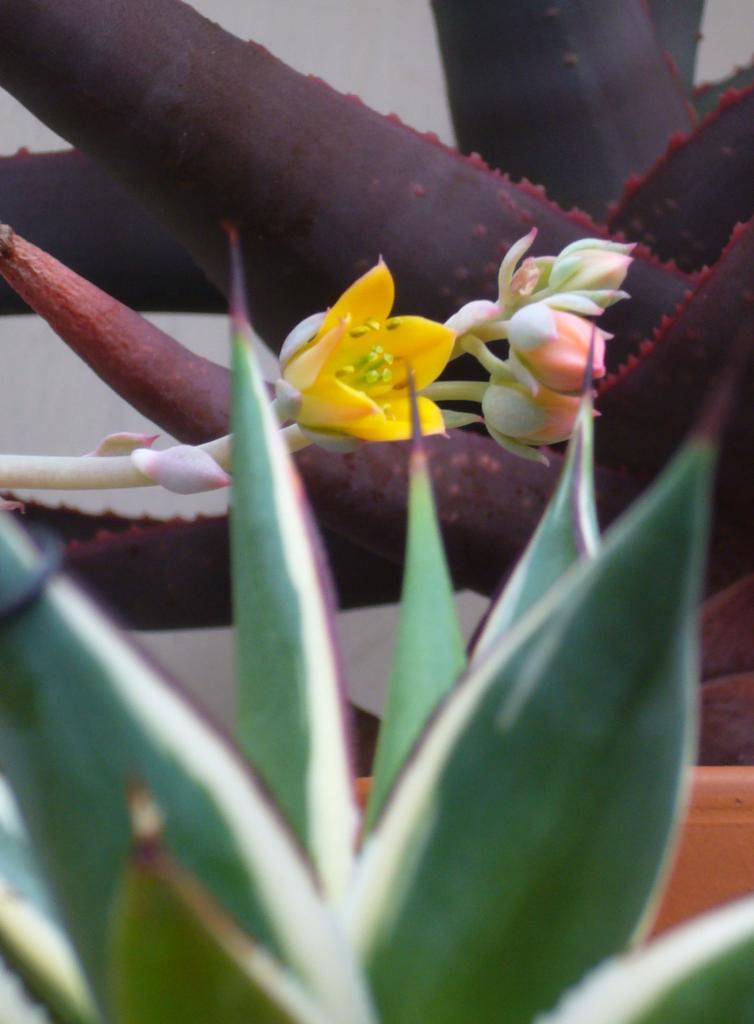
Looks like you cannot fight nature and with all the sun and warm weather we had in March everything has come into flower early this year in the shed.  Given that most echeveria flowers are yellow, the flowers are not exactly a techni-colour display. That is before you add the plants themselves still in their winter colours. Put the two together and you do get a feast for your eyes.


I love the different shapes of the flower spikes; the branched, the straight and the shepherds crook. Some go a little mad at this time of year and will need a good hack back once the flowers are over.


Some are just delicate, the graptopetalums have some of the best flowers.


Wherever you look there are flowers weaving between the other plants.


There is so much in flower I have no chance of controlling crosses, so it is down to nature this year and we shall see what it can do.

Wednesday, 28 March 2012

The next generation

I thought it was time for an update on my echeveria adonis blue hybrid.  Last summer the original plant flowered it self to death.  I did a post on it at the time (here), and showed this photo with the first offsets ready to be cut off.

Those three were cut off and when it became obvious the main plant was going to die (or look terrible) I top cut it to force more offsets. 

These all made it through winter without any problems and this second generation of plants are now ready to take over. The bowl contains the stem and offsets form the original plant, with the smaller pots being the offsets I have already removed, 16 plants in total.

I wanted to do something with these plants and had this bowl planted up with various echeverias, including one e. adonis blue.  The plants hadn't filled as hoped and I had planned to re-plant it anyway, so this seemed a good opportunity.

I used 9 of the rooted plants as a start.  As all these are established to some degree, the planter will be placed in a sunny position and once I'm 100% sure there will be no more frosts they will be fed to ensure the plants get a good amount of growth this summer. Hopefully if we actually have a summer, the plants should almost fill the planter and be producing offsets of their own in 6 months time. As you can see there is a good range of colours from blue to green depending on where the plants were over wintered.

Along with the rooted plants, there were a few still attached to the old stem.  Having top cut the original plant, these new plants formed at leaf nodes on the stem.   

In some varieties offsets start to form roots, as is the case here. This makes transplanting them easy, but you have to be careful to ensure you cut them off as close to the stem as possible.  If done carefully your offsets should have some roots which will help with the speed they establish.

Normally it is sensible to let cuttings dry off for a day or so.  If cuttings have some roots, I tend not to bother and just pot them straight away.  Having removed all the dead leaves, plant them with soil up to just below the first leaf, then top up with gravel.  The important thing at this stage is to resist from watering. Leave the plants for a week or so and then break in the watering slowly.  During this time, place the pots out of the sun, so that the plants don't get stressed.

If everything goes according to plan, in a couple of months the plants will have a good set of roots and will be ready for potting on.  These were done at the end of last summer and now have a full set of roots.  You can see that the lower leaves have died off leaving a bit of a trunk.  I don't like this and so use the potting on to plant them a bit deeper.  This will result in plants with the rosettes on the soil and new roots will form from the buried stems. 

All potted up these well rooted plants can be watered a little bit straight away.  I still place them out of the sun for a few days just in case, but they should get straight into growth. 

So my original plant has given my 16 babies to play which is a pretty good parting present. If each of these gives me even half as many I should have one or two spares next year. Now all I need is more space to store all these new plants!

Sunday, 13 November 2011

The last cross of the year

Echeverias are great succulents. They grow quickly and can go from seed to flowering within 2 years.  They can be propagated using different methods and recover quickly.  Finally different varieties flower at different times of year, so there are always some in flower. All of these make the ideal plant to hone you skills.

The first hybrids I tried were echeverias and now every year I can't help but try one or two. The selection of parents depends on what I have on the go; in quiet years I may try a few different combinations, in busier times it may just be one choice pair. This year I had planned to do my crosses at the start of the summer, but got distracted and hadn't done any until the last few weeks.  The main cross I have hopes for are two of my favourites. The first parent is one of the very white varieties e. 'john catlin'.  I get a lot of requests for this plant as it doesn't offset and is difficult to propagate.


The other parent is one of the rarer varieties e. walpoleana. This is a small clump forming plant, which has longer leaves and larger dark pink flowers.


I will be happy with any resulting cross, but a blonde (white) version of e. walpoleana would be particularly good.

Friday, 11 November 2011

Attempting an aloe hybrid

While we're on the subject of seeds, nothing shows the depth of my obsession more; I just can't help myself.  Every year I try a few seeds I have purchased and also try to create a few hybrids of my own.  Normally the hybrids are echeveria as they grow so quickly. This year I thought I would also try an aloe or two.

I wanted to try something I could not find else where; maybe more cold tolerance, or a darker colour.  This time I thought I would go with colour.  I've had this group of aloe midnight child for a while, it is a cute little plant with very dark, at times almost black leaves. The colour is amazing, but the leaves lack a little bite; they are slim and smooth with limited teeth.

This year I managed to pick up this little aloe donnie. The plant has a much nicer shape and good texture to the leaves, a trade mark of KG hybrids.  Both would enhance the aloe midnight child. 

In the US KG plants are protected by plant patents so can not be used for commercial propagation unless under license. The patent is not binding in the UK although the importers have to have a licence and my plant came from a licensed supplier. As this experiment is purely for my personal collection there wouldn't be a problem even is I was in the US.

With the parents selected, I had a couple of other aloes in flower at the same time and I cut those stems off to ensure there was no random pollination. Then using a tiny paintbrush transferred pollen from the a. donnie to the a. midnight child. 

After a week there are 4 seed pods forming and it shouldn't be too long until they open and I get to see if they contain any seed. Even if there is, there is no guarantee it is viable. So it will be a waiting game for germination and finally keeping my fingers crossed that I don't kill all the seedlings. All of this in the hope that one of the resulting plants will be something different.

Wednesday, 27 April 2011

Is this the end for plant number 1?

I have been posting updates of my echeveria adonis blue hybrid as they develop (the hybrid, the flower). I have been wondering how much flowering will spoil the look of the plant and what will happen to it once the flowers have finished.  As you can see below is still going strong a month after it started flowering.


There are two types of echeveria flowers, those that flower off the stem in which case the plant just continues growing from the growth point, or flowers that form from the growth point meaning the plant has to branch or offset to continue growth. The parents fall into both groups, e. pulidonis flowers off the stem (although it can put so much energy into flowering that it puts out offsets to survive) while e. rosea branches with each stem eventually becoming the flower.  The initial signs were that this hybrid would flower off the stem, but looking now the growth point also seems to be a flower stalk with no new leaves forming.  I am not sure if you can make it out in this photo.


If this is the case I can only guess what will happen next, I am assuming the main plant will slowly be taken over by pups (of which there are plenty).


In some respects I am pleased; I preferred it's more compact rosette form before flowering anyway, all the pups are doing well and growing away (I have already removed 8 and there are another 8 growing now).  It will also mean I have seen its entire life cycle from seed through to clumping in a 3 year period. It will be a shame to loose this first plant though, as it was this one that started all the fuss.

I probably need to start thinking about what to do next; do I leave the plant to see what happens, or top cut it to force more offsets? Who knows it may even continue growing in some weird way once the flowering has finally finished.  I have enough offsets now not to worry about the next generation (although not enough to meet demand) so maybe I should leave it to a natural outcome, something I very rarely do with my plants.

Normally when you get a plant you know what to expect, or can at least look it up.  It has been great fun not knowing what to expect and documenting everything for the very first time. With the next generation all planted out in different locations I am looking forward to learning more as they grow and who knows mum may have one or two more surprises left for me yet.

Monday, 21 March 2011

Echeveria hybrids first flowers

Having spent a few days on the beautiful Dorset coast coast I was going to post about that.  Then I got home to find that my echeveria hybrid is flowering.  I posted about the hybrid before and how pleased I was about its development. So waiting for its first proper flowering season is the last piece of the puzzle and as the Dorset coast will still be there for a few days longer (hopefully) I thought I would show the flowers first.

Echeveria flowers take different forms,  this type would fit in the shepherd's crook style due to the distinctive shape. They match their mother in that respect and are the same as echeveria pulidonis.  The yellow colour is similar as well, although given that echeveria rosea also has yellow flowers that is no surprise.

There are quite a few flower stalks which is always good and the flowers themselves are bigger than for plain pulidonis. It would have been nice if they were a little more different,  but I can't complain that much. They are flowering earlier than Pulidonis although that could just be this year,  it will take a couple of years to confirm their exact flowering period.

At this point I should really be pollinating the flowers with others from the same batch of hybrids.  Then growing the seeds and repeating two or three times.  Then the seeds should hopefully be stable and come true if grown else where. This is how you ensure that seeds produce a standard set of plants and is why producing new hybrids is such a slow process.  This year though I am going to have to wait and all propagation is going to have to be through offsets.  I have taken 6 pups off already and these will be grown to give me a good collection of plants. Maybe next year I'll start mass production.

As for the name, you may be wondering what I decided to call it.  In the end the voting went for echeveria adonis blue. Who knows one day it may appear in a garden center near you.

Tuesday, 16 November 2010

Name this plant.

In an earlier post I showed a few echeverias which are one of my favourite groups of plants. Alongside propagating through offsets and leaves, I have been experimenting with growing them from seeds.  They are easy to propagate this way the only problem is knowing exactly what the other parent is as they will hybridize very easily.

Taking advantage of this every summer I play cupid and using a small paint brush take the pollen from one plant and spread it inside the flower of a second.  For my first attempt there were a few varieties in flower at the same time, so I choose two of my favourites, echeveria pulidonis and echeveria rosea.

Echeveria pulidonis is a very neat compact plant, which offsets well and has pretty little yellow flowers. While not being totally hardy,  it does have some tolerance of cold.

Echeveria rosea is a more bushy plant which for much of the year can look a little messy.  However come winter the whole plant turns red and then from very early spring the end of each stem becomes a flower spike the biggest of any variety.  It also has the distinct advantage of being by far the best suited for growth in the UK and can be left outside unprotected in many parts of the country.

To be honest as a first attempt I didn't expect it to work, so was amazed when one of the seed pods opened to reveal tiny seeds.  I thought there was no harm in seeing if they would germinate,  and again was surprised when after a couple of weeks the tray was covered in new seedlings.  I mentioned yesterday that my skills at killing seedlings is unmatched and as usual I I did kill a fair amount but some made it through.

But what chances they would be anything different?  At first they looked similar to e. pulidonis, but by the end of last summer they were already starting to show differences,  the leaves seemed longer and the rosette looser.  To test the hardiness I left a few in various places, although only small they all survived despite our terrible winter.  At the start of spring they looked like this:

 As the summer progressed they grew and I'm not sure what I was feeding them but their growth rate was much quicker than normal, by July it was a fine plant and was obviously something special and had started to offset.


I am particularly pleased that it has kept its blue colour.  At this stage it was about the size that pulidonis normally gets to, but this one carried on and had to be repotted.  It now looks like this:


It is about 20cm across and has loads of offsets forming. A monster by plain e. pulidonis standards, I will be watching it closely next spring to see if it can get any bigger! I have also left a few outside to again test the hardiness.  While I love it, it has now raised a new problem of what to call it.  I have already been asked for offsets by a couple of nurseries and so I have to think of a name to stamp my mark on it.  Originally I had thought of combining the two parents; something like "pulosia"  or "pulidosia"  but was recently informed that this is not allowed.

So what to call it?  Any suggestions?